


- Folder Science News
- Views 870
- Last Updated 05/05/2026
From August 2026, food packaging in the EU will be subject to strict PFAS limits with three thresholds, requiring laboratories to develop a two-tier analytical process to generate legally valid data, while also preparing to expand to other substances such as BPA and NIAS in recycled packaging after 2030. The National Institute of Food Safety and Hygiene Testing fully meets the requirements for two-tier analysis according to EU standards.
PFAS are man-made chemicals consisting of partially or fully fluorinated alkyl chains (typically C4-C16) and a hydrophilic functional group. Due to the stable C-F bond, they are water- and grease-resistant and highly persistent in the environment. PFAS enter food mainly via bioaccumulation in the food chain and migration from contact materials, particularly packaging. Non-stick coatings are stable, but grease repellents on fast-food wrappers and microwave popcorn bags pose a migration risk, as short-chain PFAS can detach from the substrate polymer-especially in Asian products, which still use long-chain PFAS.
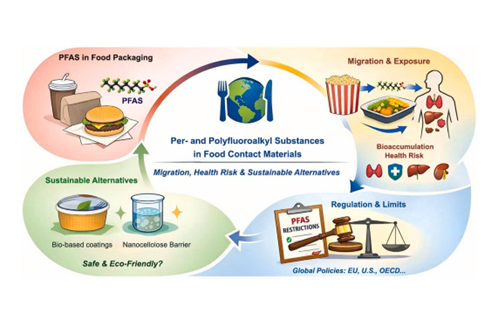
PFAS are a hazard of concern in food packaging
In the EU, a 2020 risk assessment revealed that part of the population exceeded the tolerable weekly intake of 4.4 ng/kg body weight/week. Regulation (EU) 2023/915 set maximum limits for PFOS, PFOA, PFNA, PFHxS, and their sum in meat, fish, and seafood. For food packaging, PFAS are primarily regulated under Regulation (EU) 2019/1021 on persistent organic pollutants (POPs). Annex I prohibits the manufacture, use, and market placement of listed substances. Initially, only PFOS and derivatives were banned. Later, PFOA and its salts (EU 2020/784) and PFHxS and its salts (EU 2023/1608) were added. These updates reflect a shift from controlling individual compounds to a broader approach that includes precursor substances capable of degrading into regulated PFAS
In 2024, the EU adopted Regulation (EU) 2025/40 (Packaging and Packaging Waste Regulation, PPWR), which sets PFAS limits for food packaging. Effective August 12, 2026, food contact materials and packaging containing PFAS at or above the following thresholds are prohibited from being placed on the market:
- 25 ppb for any individual PFAS (measured by targeted analysis, excluding polymeric PFAS during quantification);
- 250 ppb for total PFAS concentrations (measured by targeted analysis, excluding polymeric PFAS). Optionally, a precursor conversion step such as the Total Oxidizable Precursor (TOP) assay may be used to transform PFAS precursors into detectable forms.
- 50 ppm for total PFAS content (including polymeric PFAS). If total fluoride exceeds 50 ppm, the manufacturer, importer, or downstream user must provide analytical evidence demonstrating whether the fluoride originates from PFAS or from non‑PFAS fluoride compounds
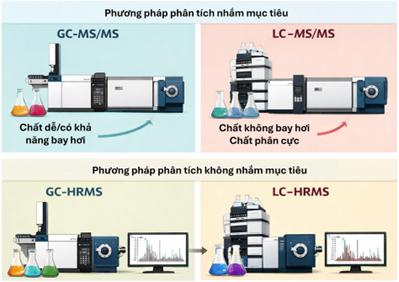
PFAS analysis techniques specified in PPWR
In practice, these limit values require laboratories to do more than simply run samples-they must develop a smart two‑tier screening process (total fluorine first, targeted PFAS second - see illustration below), using validated methods with low measurement uncertainty, covering the broad definition of PFAS, while strictly controlling background contamination due to the complexity of various packaging types. At the National Institute of Food Safety and Hygiene Testing (NIFC), the current equipment and personnel capacity fully meet the requirements for PFAS analysis in food packaging under Regulation (EU) 2025/40. For targeted analysis at the 25 ppb (per substance) and 250 ppb (total non-polymer PFAS) thresholds, NIFC is equipped with LC-MS/MS and GC-MS/MS systems offering adequate sensitivity and reliability. To perform total fluorine screening and PFAS precursor identification as outlined in the EU's stepwise guidance, the institute also possesses two high-resolution mass spectrometry systems: GC-HRMS (Orbitrap Exploris GC 240) and LC-HRMS (Dionex Ultimate UHPLC coupled with Q-Exactive Orbitrap MS). These enable the Total Oxidizable Precursor (TOP) assay and non-targeted analysis to assess the 50 ppm total PFAS limit (including polymers). Furthermore, NIFC's research staff have the necessary experience and expertise to identify PFAS across diverse sample matrices, including food packaging and contact materials.
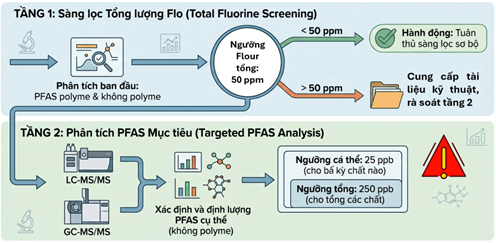
PFAS stratification analysis procedure as guided by PPWR
References:
- European Union, Regulation (EU) 2025/40 of the European Parliament and of the Council of 19 December 2024 on packaging and packaging waste, amending Regulation (EU) 2019/1020 and Directive (EU) 2019/904, and repealing Directive 94/62/EC (Text with EEA relevance). 2024. Accessed: Apr. 08, 2026. [Online]. Available: .
- R. Li et al., "Per- and polyfluoroalkyl substances in food contact materials: Migration, health risks and sustainable alternatives," Trends in Food Science & Technology, Mar. 2026, doi: 10.1016/j.tifs.2025.104625